 |
|
 ToddKolbGolf
|
Channel
ToddKolbGolf
|
Channel



How to Chip the Ball: Key Strategies for Amateur Golfers
You Might Think You Know How to Chip. But You’ll Keep Struggling With Contact Until You Learn These Lesser-Known Tips.
When you know how to chip the ball, you can turn a likely bogey into a birdie. You can smash your handicap without adding a single yard to your drive. You can take pressure off your putts.
Solid, consistent chipping is a universal game-changer. It doesn’t matter how old you are or how long you’ve been playing. This skill levels the playing field.
But very few amateurs have mastered it.
If you’re still suffering from miserable contact and terrible distance control, I’ve got some great tips for overcoming the biggest obstacles to better chipping.
I’m going to give you my top chipping tip (this one got me over 4 million views on YouTube). You’ll also get my take on the old “hinge and hold” advice (it’s a little controversial), and you’ll leave with a chipping drill guaranteed to improve your contact.
Let’s get to it.
How to Chip the Golf Ball: Key Points
Here’s the short version of everything you’re about to learn:
- Bounce is your friend when it comes to chipping.
- To use wedge bounce correctly:
- Set up with the butt end of the club equal to the golf ball or on the front side of the ball.
- Open the face very slightly at setup.
- As you begin your backswing, move the butt end of the club in the same direction as the clubhead.
- The popular “hinge and hold” advice isn’t bad, but it only works if you’re able to make ball-first contact every time.
- To improve contact, try the Lead Foot Only Drill—take practice swings balanced only on your lead foot, using your trail foot as a kickstand.
The Number One Secret to Better Chipping
If you only take one thing away from this article, let it be this:
Bounce is your friend when it comes to chipping.
The kind of friend that asks about your mother and shovels your sidewalk when you’re recovering from surgery. When it comes to chip shots, bounce is there to support your goals and help you get through obstacles.
So the last thing you want to do is get rid of it.
And What is Bounce?
If you look at your wedge, you’ll see that it’s curved on the bottom. That’s bounce.
This design allows your club to bounce through the turf instead of digging into it.

You don’t have this same feature on your irons because you don’t need it. If the leading edge of your iron grabs the ground at 80 mph, it’s going to take a divot and keep going. That’s what we want for iron shots.
But on a chip shot, you’re swinging a lot slower. If the leading edge of your wedge catches the ground, it’s going to dig in hard, interrupt the motion, and destroy your contact.
That’s how you end up with those cringeworthy chili dips and topped shots. You’ve done something in your setup or swing motion to negate the bounce—to cause the leading edge to make contact with the ground instead of the rounded sole designed to glide through it.
Here’s how to stop doing that:
How to Use Wedge Bounce to Improve Your Chip Shots
The first thing amateur golfers should learn about how to chip the ball is how to use wedge bounce.
Unfortunately, they often don’t. They may even learn bad habits that negate the bounce. And these bad habits tend to arise in the setup and swing motion.
The Ideal Setup for Chip Shots
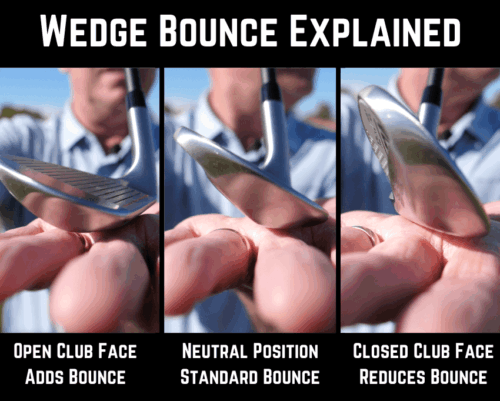
In your setup, you want the leading edge of your club to come up off the ground. This happens naturally when you hold the club in the neutral position.
But lean the shaft farther forward, and the leading edge of the clubhead touches the ground. This negates the bounce. If you make your swing from this starting position, you’ll return to that position at impact, digging into the ground and hitting it fat.
That forward lean is one of the most common chipping mistakes I see among amateur golfers. To avoid it, set up with the butt end of the club equal to the golf ball or on the front side of the ball. No farther forward than that.

You also want to keep an eye on face orientation. A closed clubface negates bounce. Rotating the face open adds bounce.
Of course, you don’t want to open the face too far, or it’ll destroy your aim. A very slightly open orientation—we’re talking maybe 3-4°—is plenty.
The Best Swing Motion for Chip Shots
Another place where amateur golfers inadvertently negate bounce is in their chipping motion.
When they swing back, they hinge the butt end of the club toward the target. This creates a forward shaft lean—the same problem we discussed in the setup. That forward lean exposes the leading edge, and the golfer will likely hit it fat.
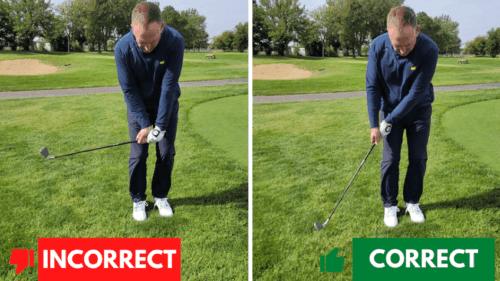
Now, you may have learned that hinging on the takeaway is a good thing. And yes, this works great for some golfers, but you need a lot of precision and control to reap the benefits.
We teach it differently in the Vertical Line Swing System, because the entire point of the VLS System is to get better results by simplifying the strategy.
In our system, we teach golfers to initially move the butt end of the club in the same direction as the clubhead. As the clubhead travels away from the golf ball, so should the butt end of the club.
It helps to think about the logo on your golf glove. If you feel the logo on your glove work back and away from the target on the takeaway, you’re doing great.
Is Hinge and Hold Really the Best Strategy for Chipping?
You may have noticed that my last tip directly contradicts one of the most popular chipping tips in modern golf: hinge and hold.
I’m not going to say that this strategy is wrong or even ineffective. It comes from one of the greatest chippers of all time (drop a note in the comments if you know who it is), and this method has served him and countless other golfers very well.
The reason I don’t promote hinge-and-hold when I teach amateur golfers how to chip is that this technique gives you very little margin for error.
You have to be able to make ball-first contact every time. If you don’t, the ball will come out low and hot.
Most everyday golfers don’t have that kind of control and can’t spend hours upon hours sharpening those skills. They just want to hit better chip shots and have more fun around the green.
So if that’s you, I say keep it simple. Stop trying to make hinge-and-hold work for you.
The Best Drill to Improve Your Chipping
Having said all that, it’s still worth working to improve your control when it comes to contact on those chip shots. Maintaining bounce does a lot to help you survive an imperfect shot, but we might as well make our chip shots the best they can be.
One of the biggest chipping mistakes amateur golfers make is tilting their upper body away from the target as they swing through. This shifts the low point, rendering a perfect setup pointless.
Unfortunately, this error happens instinctively when you’re focused on lifting the ball into the air. So we have to train a new instinct. The Lead Foot Only Drill is perfect for that.
Lead Foot Only Drill
- Instead of taking your regular chipping stance, position your lead foot in line with the golf ball.
- Balance all your weight on the lead foot, resting the toe of your trail foot on the ground behind you for support. (You can lift the trail foot if you prefer, but I typically recommend using it as a kickstand for the sake of safety and stability.)
- Make three swing motions from this position.

After you’ve done that three-setter, set up to the ball with all the key ingredients of your chipping setup in place:
- Position the ball in the center of the heels
- Open the clubface slightly
- Position the butt end of the club even with the golf ball or on the front side of the golf ball
Then take a real shot, remembering to keep your weight forward throughout the motion and work the logo of your golf glove away from the target on the takeaway.
Odds are, you’ll have an easier time keeping that upper body steady, maintaining that all-important bounce, and making much better contact.
Next Steps for Even Better Chip Shots
I have no doubt you’ll start seeing more consistency and better contact with the tips you’ve just learned. But if you want even more improvement, here’s what you should check out next:
The 3 Biggest Chipping Mistakes Amateur Golfers Make – This short video lesson has been an eye-opener for a ton of golfers just like you. One golfer said they wish they’d seen it 20 years ago.
The Easy Break: A Radically Simple System for Better Putting, Chipping, and Bunker Play – I wrote this bestselling book to finally simplify the short game for everyday golfers. It’s packed with drills, checklists, practice plans, and loads of actionable advice.
And to make really fast strides in your short game, try the Align Grind Wedge. This short-game club was designed specifically for amateurs (though it looks like a tour player’s wedge) and has ultra-forgiving features like shot-correcting Perimeter Payload Weighting and the ground-hugging Align Grind Sole.
It’s also built for versatility, so you can use it on a wide variety of short-game shots. That gives you plenty of opportunities to truly master this one, rather than constantly cycling through different wedges, never feeling confident with any of them.
To get a closer look at the Align Grind Wedge, you can read our review here.

Finally, if you’re really serious about advancing this and all other aspects of your game, check out VLSCoaching.com. You get direct access to me as well as world-class instructors from all corners of the industry. Plus, you get opportunities to hang out with friendly golfers from all over, both online and in person.
Now, before you go…
Drop Into the Comments and Share Your Thoughts!
I gave some controversial advice in this one, and I’m eager to hear what you think. Do you agree? Disagree? Have you had any success trying these tips? Do you have any questions for me?
We always love hearing from you, so be sure to chime in.
About the Author
I’m PGA Teaching Professional Todd Kolb—a five-time Golf Digest Best-in-State Instructor, Amazon Best-selling Author, and Minnesota PGA Teacher of the Year. I’ve worked with students of all ages and skill levels in my 30 years of coaching, from first-timers to an LPGA major champion. I’m also the Director of Instruction for VLS Golf and USGolfTV.
My work with VLS Golf and USGolfTV revolves around helping the everyday golfer cut through overcomplicated traditional instruction to find solutions that actually work for them.