 |
|
 ToddKolbGolf
|
Channel
ToddKolbGolf
|
Channel



How to Hit a Fairway Wood: Make Solid Contact Every Time
Most Amateur Golfers Can’t Hit Their Woods Off the Turf. Be the Golfer Who Actually Knows How to Hit a Fairway Wood.
It’s not just you. About 90% of golfers can’t make solid contact with their fairway woods when they’re hitting it off the ground. Not consistently, anyway.
The good news is, there’s a reason for this. And once you understand the reason, you’ll finally understand how to hit a fairway wood.
Stick around, and you’ll learn why you’re getting rotten contact with your woods, two easy changes you can make to remedy the issue, and one unbelievably simple tip guaranteed to improve your contact instantly… no practice necessary.
How to Hit a Fairway Wood: Key Points
Here’s the short version of everything we’re about to cover:
- The length and low loft of your fairway woods make these clubs uniquely difficult to hit, especially off the ground.
- You can improve your contact by shifting your weight throughout your swing. You should finish with your weight on the lead foot, not the trail foot.
- To ensure you make contact at the low point of your swing, position the golf ball between the buttons and logo of your golf shirt.
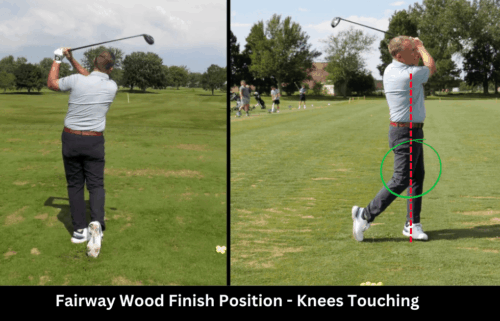
- For an instant fix, make sure your knees are touching when you finish your swing.
Why Is It So Hard to Hit Your Fairway Wood Off the Ground?
So what’s behind the struggle? Why do amateur golfers—even amateur golfers with a pretty decent swing—not seem to know how to hit a fairway wood?
Why are you flushing your irons but topping your 3-wood?
Simply put, fairway woods have a tricky design.
The long shaft makes it more difficult to control the clubhead. And the major clubmakers are starting to make fairway woods even longer for higher swing speed.
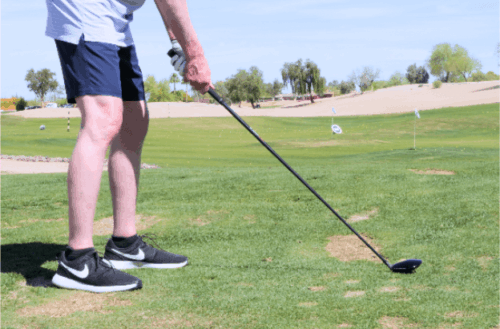
Unfortunately, the only players who really benefit from that design are the professionals who have the time and resources to hone their precision skills. It takes serious practice to control a club that long.
The other feature working against you is the low loft. Not only does the low loft make it harder to get decent launch off the turf, but it also causes you to make shot-sabotaging moves in an effort to get the ball in the air… moves you’re probably not even aware you’re making.

So how do you get around these issues?
Well, one really easy fix would be to get a fairway wood specifically designed to help amateur golfers get better contact and launch. (The VLS Hypermax is the only one I know of.)
But the following advice will also get you better results with any club.
How to Fix Your Contact With Fairway Woods
There are two elements amateur golfers tend to get wrong when it comes to hitting fairway woods off the ground: weight shift and ball position.
When you understand these two elements better, you get much better contact.

Master Weight Shift
What most golfers get wrong:
A lot of golfers shift their weight to their trail foot on the backswing (great) and then stay there through the finish (not so great).
Now, if you notice that you’re finishing your swing with your weight on your back foot, you probably have a good excuse.
Remember the issue with your club’s low loft? You know your fairway wood is tough to launch. So, most likely, you’re subconsciously trying to lift the ball into the air by leaning into your back foot.
But doing this brings the low point of your swing farther back, brings the club up into the air too early, and ultimately causes you to top the ball.
How to do it right:
What you want to do is allow your weight to shift with the motion of your club.
- Start with about 60% of your weight in the lead foot at setup.
- Shift most of your weight into the trail foot on the backswing.
- Shift the weight back into the lead foot as you swing down and through.
I recommend using the Right, Left Drill to practice this.
Right, Left Drill
- Step back from the ball and take your regular setup position.
- Swing the club repeatedly in one continuous motion—back and through, back and through.
- As you swing back, say “right” (out loud or in your head, doesn’t matter which) and shift your weight into your right foot.
- As you swing forward, say “left” and shift your weight into your left foot.
- Continue until the motion feels natural.
- Step up to the ball and take a shot, maintaining the weight shift you just drilled.
Obviously, if you’re left-handed, you’ll reverse the directions. You’ll say “left” as you swing back and “right” as you swing through.
I love using this drill with my students because it’s fun, simple, and helps them find that natural weight shift right away. It’ll also help you stop topping your fairway woods.
Find the Proper Ball Position
What most golfers get wrong:
With an iron, you want to hit down on the ball, catching it just before the low point of your swing.
With a driver, you’re trying to hit up on the ball, making contact just after the low point.
But when it comes to a fairway wood, you want to make contact right at the low point. A lot of golfers miss this. So if your fairway wood setup looks the same as your setup for your irons or driver, I can guarantee you’re getting lousy contact.
How to do it right:
To make sure you make impact at the low point of your golf swing, you want the ball somewhere between the buttons and logo of your golf shirt.
To find the perfect ball position:
- Stand with your feet together and the ball in the center of your feet.
- Step your lead foot towards the target just slightly—maybe somewhere between 2 and 3 inches.
- Take a much larger step away from the target with your trail foot, finding the stance width that feels stable for you.
- Check that the ball aligns with the space between the logo and buttons of your shirt. If it does, you’ve got the ball in the right position.
A Tip for Fixing Your Contact With Fairway Woods Immediately
You’ll already get quick results with the advice I just gave you. You may need to run the drills a few times to turn the proper weight shift and ball position into a habit, but it won’t take long.
That said, I’ve got one last tip you can take to the golf course today for immediate improvement in your contact with fairway woods.
When you finish your shot, make sure your knees are touching.
That’s it. Make sure you end your swing in that position, and you’ll naturally find a better swing and end with your weight on your lead foot.
I know it sounds too good to be true, and it’s okay if you don’t believe me. Just try it once and see what happens. If it works, make sure you come back here and jump into the comments to tell your fellow golfers they can trust me on this one.
The Best Fairway Wood for Amateur and Senior Golfers
I’d like to offer one last piece of advice before you go.
You’ll definitely see notable improvement when you follow the three tips I just gave you. But you’ll still have an uphill battle playing with a club that was designed for tour players.
All the big-name clubmakers design their clubs to get the best performance from a professional skill set. And to be perfectly honest, what works for them often doesn’t work for the rest of us.
If you want to make this journey easier on yourself, check out the Hypermax Hyway Wood. It’s the only fairway wood designed specifically for amateur and senior golfers.

It’s got higher loft for much easier launch off the ground, a traditional shaft length, an Easy Launch Sole that glides through the turf instead of digging in, and a whole host of other features to ensure better contact, launch, and distance for slower swing speeds.
You can read our review of the Hypermax here.
Whatever steps you take as you work to play better golf, remember to leave a comment below and let us know how it’s going. I read comments every day, and the more you share, the easier it is for me to provide the kind of instruction you need.
So join the discussion!
About the Author
I’m PGA Teaching Professional Todd Kolb—a five-time Golf Digest Best-in-State Instructor, Amazon Best-selling Author, and Minnesota PGA Teacher of the Year. I’ve worked with students of all ages and skill levels in my 30 years of coaching, from first-timers to an LPGA major champion. I’m also the Director of Instruction for VLS Golf and USGolfTV.
My work with VLS Golf and USGolfTV revolves around helping the everyday golfer cut through overcomplicated traditional instruction to find solutions that actually work for them.